Macro Stackers makes one product, and the prompt I tested describes it almost word for word. The 24 oz containers are made from bamboo fiber with a plant-based lining and lid, and the product page says “Microwave & freezer safe.”
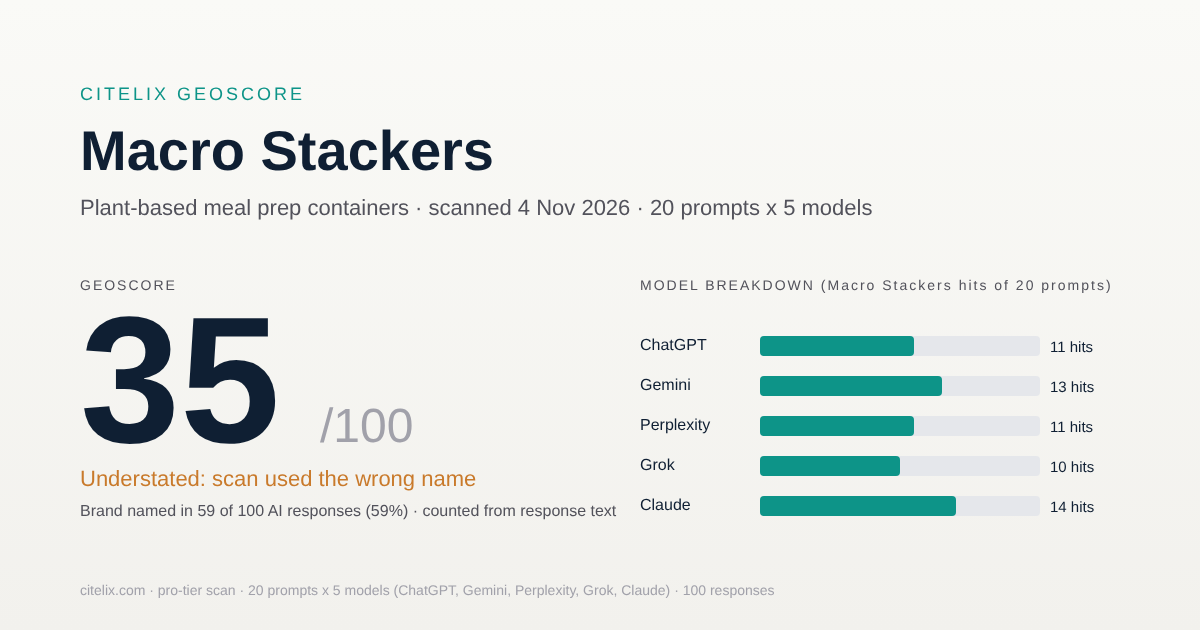
Across ChatGPT, Gemini, Perplexity, Grok, and Claude, Macro Stackers is named in 59 of 100 responses. Its Citelix GeoScore is 35 out of 100, which undercounts it: the scan matched the brand as “Macro Stacker Meal Prep Containers” and missed shorter mentions.
The prompt I tested
The scan ran 20 prompts. The anchor for this teardown:
“What are the best eco-friendly meal prep containers that are microwave safe?”
Why this prompt: it is the brand’s pitch phrased as a question. A 30-pack of Macro Stacker 24 oz containers is $39.99, or $33.99 on subscription.
What the AI models said
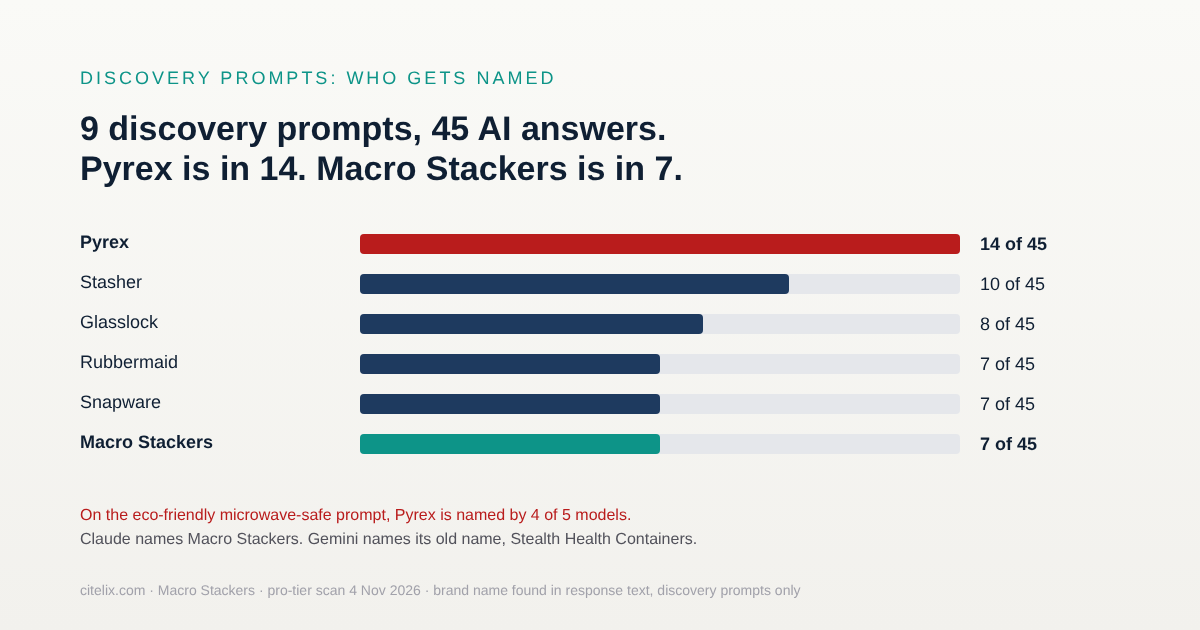
Pyrex was named by four models. Macro Stackers was named by one, and a second model named it under its old name.
- ChatGPT opened with “Glass Meal Prep Containers” and listed Pyrex first, “Made of durable borosilicate glass.” No Macro Stackers.
- Grok led with “Tempered-glass containers (the gold standard)” and put Pyrex Simply Store first. No Macro Stackers.
- Perplexity chose OXO Good Grips Smart Seal Glass as “Best overall” and Pyrex Simply Store as “Best value.” Its sources were Food Network, CNN, Allrecipes, Forbes, Business Insider, and four other sites. No Macro Stackers.
- Gemini listed Snapware, Rubbermaid, and Pyrex glass first. Under plant-based fiber containers it named “Stealth Health Containers,” with “bamboo-fiber bases with snug lids.” That is Macro Stackers’ old name; stealthhealthcontainers.com now redirects to macrostackers.com.
- Claude opened with Macro Stackers: “100% plant-based meal prep containers, including the lining and lid.” It cited macrostackers.com. It also closed with the catch: “plant-based options are compostable but single-use, while glass and silicone containers are reusable and durable for long-term use.”
The discovery gap
On the 11 prompts that name Macro Stacker, the models name it in 52 of 55 answers. On the 9 that do not, they name it in 7 of 45.
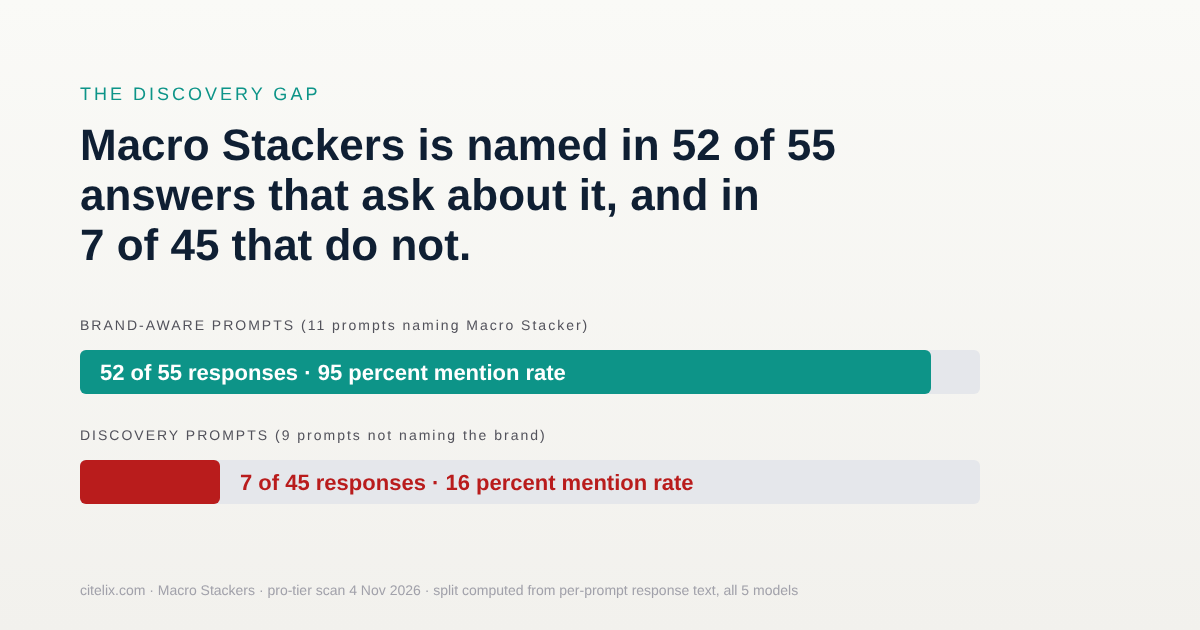
Two more discovery answers name “Stealth Health Containers” without naming Macro Stackers, both from Gemini. Counting the old name, the brand is in 9 of 45.
Why Pyrex won
1. The models read “eco-friendly” as “reusable”
Four of the five answers lead with reusable glass. Grok calls tempered glass “the gold standard.” A single-use container, however compostable, starts behind in that frame. Macro Stackers’ own page says “Single Use: Not dishwasher safe or designed for reuse.”
2. Pyrex is the default glass answer
On the 9 discovery prompts, Pyrex is named in 14 of 45 answers, ahead of Stasher at 10 and Glasslock at 8. Pyrex sells a Simply Store 10-piece Meal Prep set on pyrexhome.com, the exact product Grok and Perplexity named.
3. The roundups are written about glass
Perplexity cited nine outside pages on this prompt, including Food Network, CNN, Forbes, and BBC Good Food. None of them is a Macro Stackers page. Claude was the only model to cite macrostackers.com on this prompt, and it is the only model that named the brand.
4. Macro Stackers’ own articles use the old name
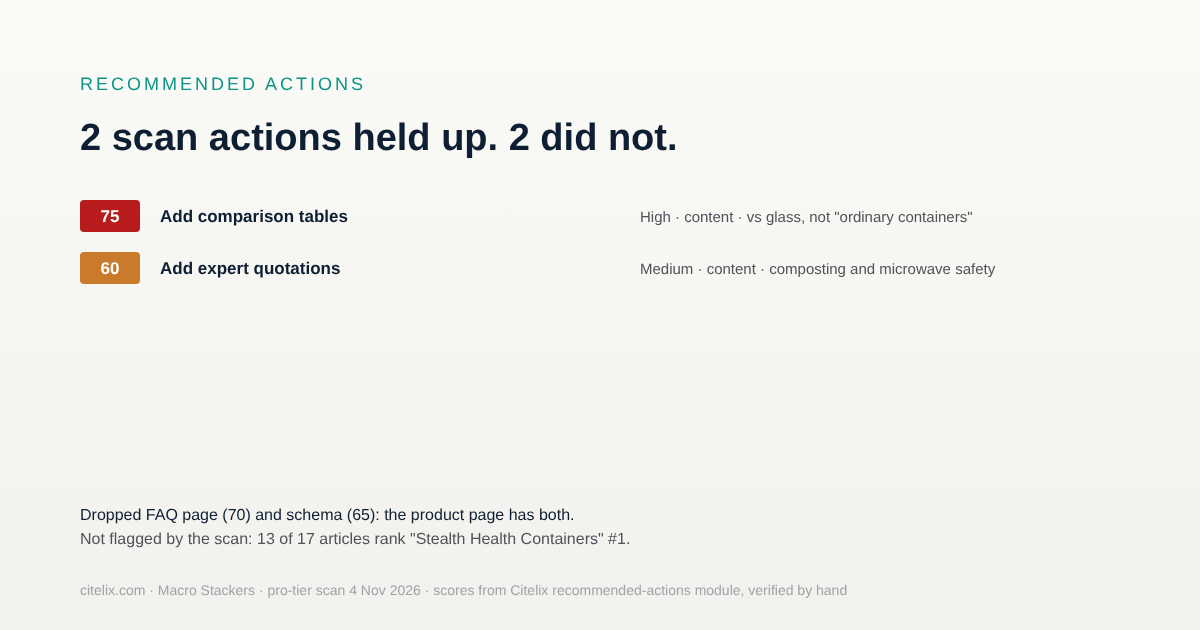
The article Claude cited, “Microwave-Safe Food Containers: 13 Picks,” ranks “#1 - Stealth Health Containers.” So do 12 more of the store’s 17 articles. Only one, the 2026 roundup, ranks “Macro Stacker 24 oz Meal Prep Containers” first and compares it with Pyrex. A model reading the blog sees two brand names for one product.
What Macro Stackers is missing
I checked macrostackers.com. The store sells 2 products, the containers and compostable label sheets, and has 17 articles in its sitemap; the ones I opened all load. The product page is strong: ProductGroup schema with offers for all three pack sizes, FAQPage schema with 13 questions, and a comparison table, all in the server HTML. Here is what is missing:
- One name. 13 of 17 articles rank “Stealth Health Containers” first.
- A comparison with glass. The product page compares the Macro Stacker to “Ordinary Containers” made of “Plastic or polystyrene.” The models compare it to Pyrex.
- An answer to “when is single-use the greener choice?” That is the question Claude raised and no page on the site answers directly.
- A rating in the schema. The ProductGroup markup has no aggregateRating.
3 fixes Macro Stackers could ship this week
Fix 1: Finish the rename
Why this matters: Gemini named the brand twice, both times as Stealth Health Containers. The blog teaches models both names.
How to do it: In the 13 articles that rank Stealth Health Containers first, change the entry to “Macro Stacker 24 oz Meal Prep Containers (formerly Stealth Health Containers)” and link the product page. Add the same “formerly” line to the product description and the Organization schema.
Estimated time: 2 hours.
Fix 2: Compare against glass, honestly
Why this matters: four models answered with Pyrex. The page compares against polystyrene.
How to do it: Add a second table: Macro Stacker versus Pyrex Simply Store glass. Microwave and freezer safety, weight, leak behavior, cleaning, cost per meal, and end of life. Say plainly where glass wins, then where a compostable container wins: batch prep, no dishwashing, gifting meals, travel.
Estimated time: 2 to 3 hours.
Fix 3: Answer the single-use question with a source
Why this matters: Claude named Macro Stackers and then told the buyer it is single-use. The next answer needs a counterpoint it can cite.
How to do it: Publish one short page, “Are compostable meal prep containers actually eco-friendly?”, with the certifications already on the product page (CMA, FSC, USDA Biobased), what commercial composting requires, and a quote from a composting or packaging expert.
Estimated time: half a day.
The 30-second version
If you only do one thing: replace “Stealth Health Containers” with “Macro Stacker” across the blog. Macro Stackers is named in 52 of 55 answers that ask about it. When a buyer asks for eco-friendly microwave-safe containers, four models name Pyrex, Claude names Macro Stackers, and Gemini names a brand that now redirects to Macro Stackers.
Methodology
I ran this scan through Citelix on 2026-11-04 (pro-tier, 20 prompts across ChatGPT, Gemini, Perplexity, Grok, and Claude, 100 responses in total, Claude collected via batch). The anchor prompt was added by hand before the scan ran; the other 19 are the scan’s defaults. The GeoScore of 35 is the scan’s final score after the Claude responses landed.
A note on brand detection: the crawler read the brand as “Macro Stacker Meal Prep Containers,” and the scan’s built-in flags counted 33 mentions. My counts come from a whole-word search for “Macro Stacker” or “Macro Stackers” in all 100 responses, which finds 59. “Stealth Health Containers” is counted separately and called out where it matters. Pyrex, Glasslock, Rubbermaid, Snapware, and OXO were not in the scan’s tracked competitor list; I counted them from the response text. I left Bentgo out of the discovery chart, because 5 of its 11 discovery mentions come from a prompt that names it.
I kept two of the scan’s five actions. I dropped “Create an FAQ Page” (70) and “Implement Schema Markup” (65), because the product page already has FAQPage and ProductGroup schema in its server HTML, and left out “Add Alt Text” (50) as lower impact. Prices come from macrostackers.com on 2026-11-04. This teardown is independent and not sponsored by either brand.
Want this teardown for your store? Install Citelix on Shopify. We scan your store across ChatGPT, Gemini, Perplexity, Claude, and Grok every day and tell you exactly which prompts your competitors win and what to change.