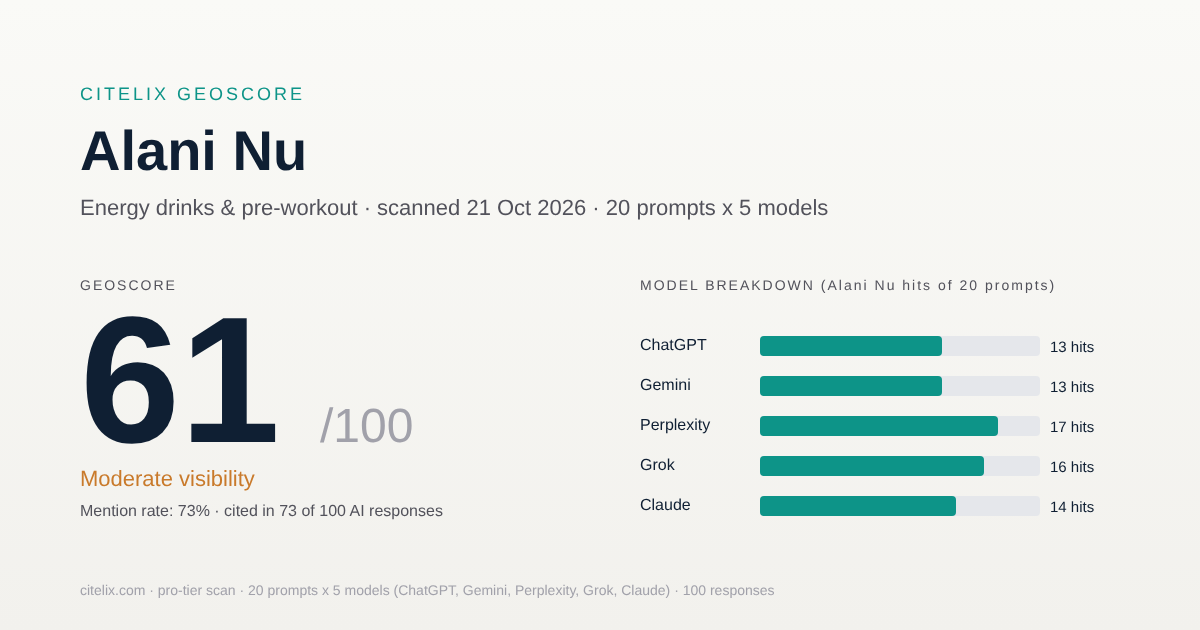
Alani Nu is one of the loudest brands in energy drinks. Big flavor drops, a seasonal potion pack, a cult following. So when I scanned it across ChatGPT, Gemini, Perplexity, Grok, and Claude this week, the headline number was strong: a Citelix GeoScore of 61 out of 100, cited in 73 of 100 AI responses, and named in every single answer to a prompt that says “Alani Nu.”
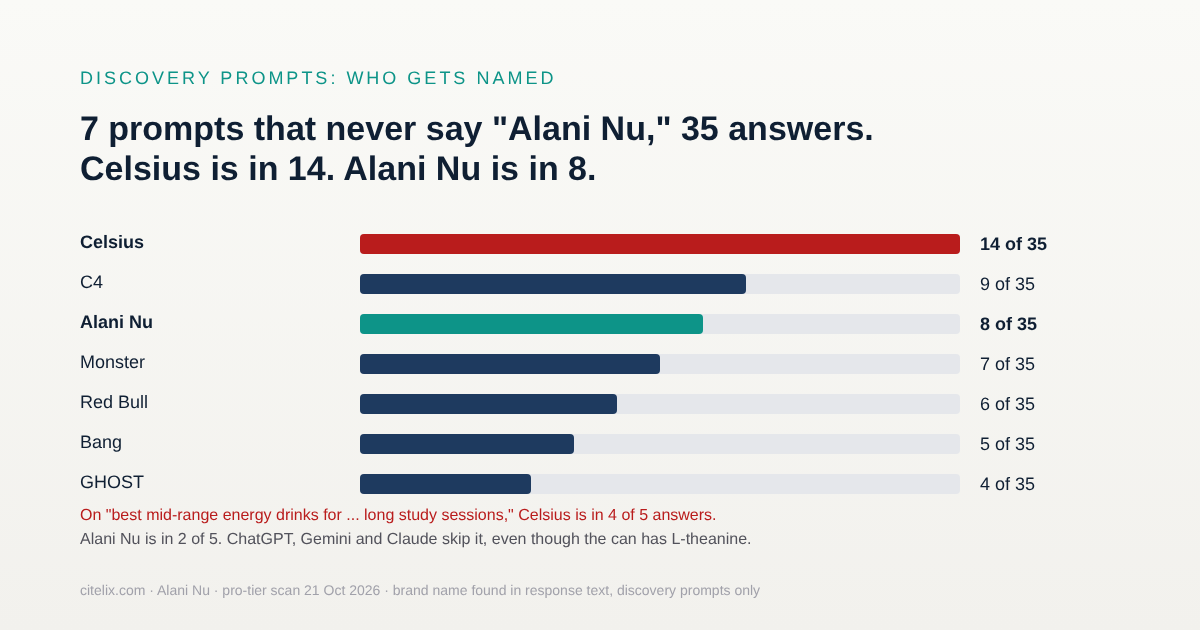
The problem shows up the moment the buyer stops saying the name. When someone asks for the best mid-range energy drinks for sustaining focus during long study sessions, ChatGPT, Gemini, and Claude do not mention Alani Nu at all. Celsius shows up in four of the five answers.
The prompt I tested
The scan ran 20 energy and fitness prompts. The anchor for this teardown:
“best mid-range energy drinks for sustaining focus during long study sessions”
Why this prompt: it is a buyer with a repeat habit (long study sessions happen every week), a price band that fits a 12-pack, and a specific job for the drink: focus, not a gym pump. A student cramming for finals is a weekly buyer, and the models are sending that student somewhere else.
What ChatGPT said
ChatGPT did not mention Alani Nu. It listed REIGN, Bang, Monster Zero Ultra, and then Celsius, which it described like this:
Celsius is marketed as a fitness drink, providing a clean energy boost with natural ingredients.
It added that Celsius is “formulated with natural caffeine from guarana and green tea.” That is an ingredient story, and it is the thing every model kept repeating about Celsius.
The other models:
- Gemini listed Bang, Rockstar Focus, and Celsius, saying Celsius “contains a blend of key vitamins, caffeine, and other ingredients like guarana seed extract.” No Alani Nu.
- Claude led with Celsius (“200mg of caffeine from natural sources with green tea extract”), then Ghost Energy for its nootropics, then C4 Smart Energy. No Alani Nu. It cited three pages, all titled some version of “best energy drinks for studying.”
- Perplexity did name Alani Nu twice: the Mini at 100 mg caffeine for “caffeine-sensitive students,” and the full can as “similar to Celsius, with 200 mg caffeine.” It also listed Liquid Death, Red Bull Sugarfree, and Celsius.
- Grok ranked Alani Nu second behind C4 Smart Energy, and it was the only model to bring up L-theanine.
The discovery gap
The pattern holds across the whole scan, not just one prompt.
- Brand-aware prompts (13 prompts that name Alani Nu, such as “Alani Nu vs Celsius” or “are there vegan options in Alani Nu’s mini energy elixirs”): Alani Nu cited in 65 of 65 responses.
- Discovery prompts (7 prompts that do not name Alani Nu): Alani Nu cited in 8 of 35 responses, about 23%.
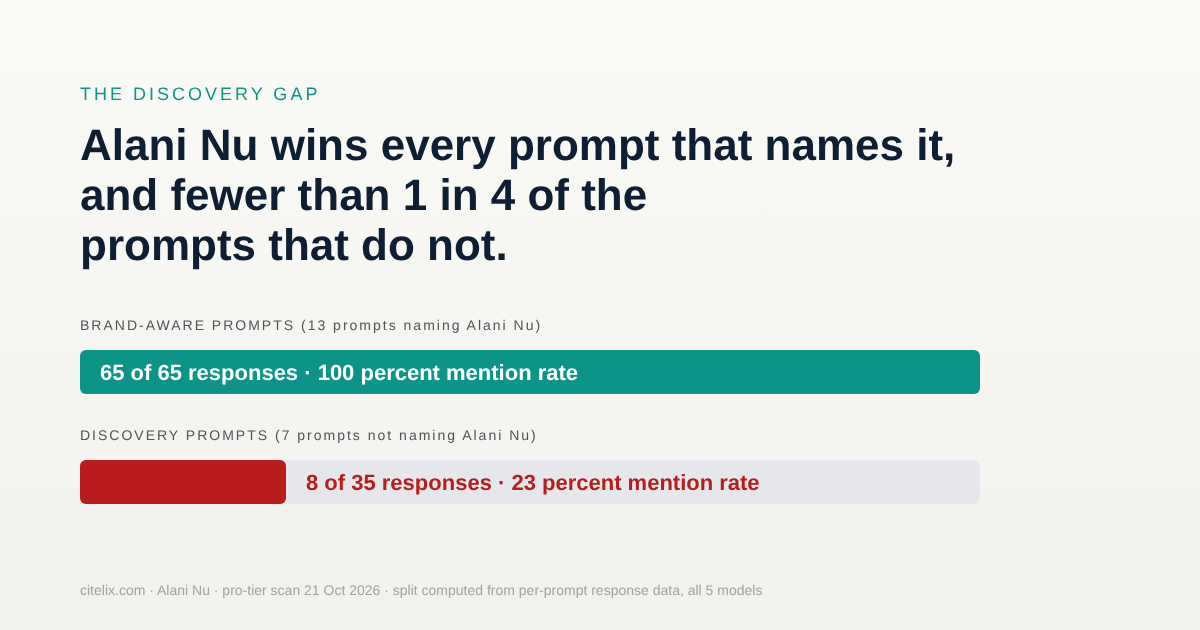
Most of the 20 prompts named Alani Nu, which is why the overall 73% looks so healthy. Strip those out and the picture flips. Two discovery prompts got zero Alani Nu mentions from any model: “best flavored energy snacks for pre-workout energy” (Clif showed up in all 5 answers) and “how to fix stomach upset after drinking energy drinks.” On the ingredients question, “what ingredients should I look for in a healthy energy drink,” Celsius was named by four models and Alani Nu by one.
Why Celsius won the study-focus prompt
I read all five answers, the sources they cited, and Alani Nu’s own pages. Four things put Celsius ahead.
1. Celsius has an ingredient story the models can repeat
ChatGPT, Gemini, and Claude all explained Celsius through its ingredients: green tea extract, guarana, “natural caffeine.” A model answering a focus question needs a reason a drink helps you focus, and Celsius hands it one. When the models describe Alani Nu, they reach for flavor: Perplexity said it “stands out for dessert- and fruit-style flavors,” and Grok mentioned “trendy flavors.”
2. Alani Nu’s focus ingredient is hidden in the fine print
This is the part that surprised me. The Cosmic Stardust can I checked lists L-Theanine and Panax Ginseng Root Extract in its ingredients. L-theanine is the exact ingredient Claude’s answer called out as the key to studying (“the caffeine-plus-L-theanine combination is superior to caffeine alone”). But Alani Nu’s product copy never mentions it. The description talks about “candy-inspired flavors” and “fruity, chewy clusters,” then “B vitamins and 200mg of caffeine.” The word “focus” does not appear on the page. No dose is listed for L-theanine either. Grok filled that gap by guessing a number I could not find anywhere on alaninu.com, which is what models do when the brand does not state it.
3. Other brands wrote the “energy drink for studying” page, and the models read it
Claude’s three sources were a Bucked Up article titled “Best Energy Drinks for Studying,” a Bulkhead Energy blog post on “best energy drink for studying,” and proteinenergy.io’s “Best Energy Drinks for Studying and Focus (2026).” Two of those are brand-owned blogs. Alani Nu has a blog too, with 13 posts, and every one of them is a recipe. There is no Alani Nu page a model could cite for a focus or study question.
4. Celsius shows up across the open questions, not just this one
Across the 7 discovery prompts and 35 answers, Celsius was named in 14 and Alani Nu in 8. C4 was named in 9. In the scan’s own tracked-competitor table, Celsius had the highest mention rate at 22%, ahead of GHOST at 15%.
What Alani Nu is missing
I checked alaninu.com by hand. Here is what stands out for this prompt:
- The product description is one flavor paragraph. On /products/energy-drink-cosmic-stardust the Shopify description is a single paragraph about taste. The ingredient list and nutrition panel are on the page, but nothing explains what the L-theanine, ginseng, or taurine are there to do.
- The product schema is good. Credit where due: the Product JSON-LD names the brand as Alani Nu and carries an aggregateRating of 4.9 from 3,794 reviews. Structured data is not the problem here.
- All 9 collections have empty descriptions. The /collections.json feed lists energy, energy-sticks, fitness, shakes, snacks, bundles, best-sellers, and others, and none has description text. A collection page is the natural home for “which Alani Nu drink is right for studying vs the gym.”
- The FAQ answers shipping, not buying. /pages/faq has around 34 questions. Most cover returns, shipping, discount codes, and the GOVX program. One asks “What do I need to know before consuming energy drinks?” None covers focus, caffeine timing, or how Alani Nu compares to coffee or Celsius. The page carries BreadcrumbList schema, not FAQPage.
3 fixes Alani Nu could ship this week
None of these need a reformulation.
Fix 1: Say what the L-theanine is for, with a number
Why this matters: the models already believe L-theanine is the study ingredient. Alani Nu has it in the can and gets no credit, because nothing on the page connects the ingredient to the benefit.
How to do it: Add two or three sentences to every energy drink product description: the L-theanine amount per can, what it does alongside 200 mg of caffeine, and who the drink suits (long work or study blocks, not just workouts). Point caffeine-sensitive buyers to the 100 mg Mini, which Perplexity already recommends for exactly that.
Estimated time: 2 to 3 hours, mostly getting the dose confirmed.
Fix 2: Publish one buying-guide page and fill the collection descriptions
Why this matters: Claude’s answer was built from three “best energy drinks for studying” articles, two of them written by other brands. Alani Nu has a blog and a collection page that could hold this answer, and both are empty of it today.
How to do it: Write a short guide on the existing blog, something like “Which Alani Nu is best for studying, work, or the gym,” with a comparison table of caffeine, L-theanine, and serving size across the full can, the Mini, and Energy Sticks. Then write a two-paragraph description for each of the 9 collections, starting with the energy collection. Add FAQPage schema to /pages/faq while the developer is in there.
Estimated time: half a day.
Fix 3: Pitch the review sites the models cite
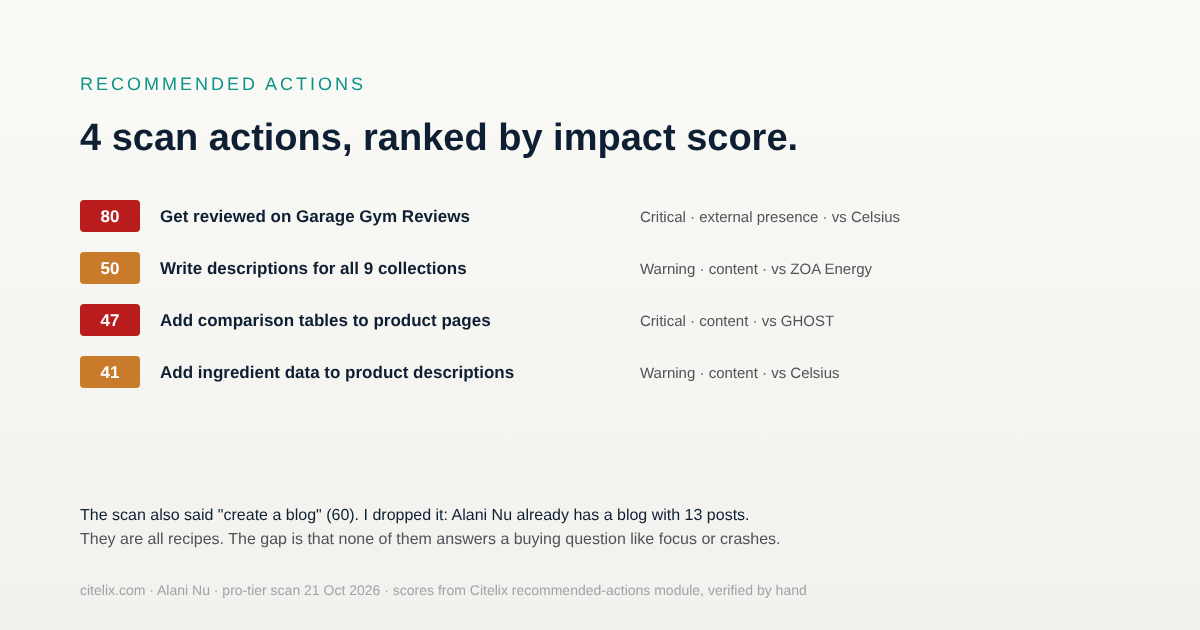
Why this matters: garagegymreviews.com was the second most-cited domain in this scan (8 citations), and the scan’s top action (80) was getting reviewed there. Review roundups are where “best for focus” and “best mid-range” labels come from.
How to do it: Send samples to Garage Gym Reviews and the “best energy drink for studying” roundups, and lead with the focus angle (L-theanine, the Mini’s lower dose) rather than flavor, which the models already know about.
Estimated time: 1 hour to send, weeks to land.
The 30-second version
If you only do one thing: put the L-theanine on the front of the page. Alani Nu wins every prompt that names it. When a student asks for a focus drink, the models pick Celsius because Celsius explains its ingredients, and Alani Nu’s focus ingredient sits unexplained in the fine print.
Methodology
I ran this scan through Citelix on 2026-10-21 (pro-tier, 20 prompts across ChatGPT, Gemini, Perplexity, Grok, and Claude, 100 responses in total, Claude collected via batch). The GeoScore of 61 is the final score after the Claude responses landed. The brand-aware and discovery splits are computed from per-prompt response data. The discovery share-of-voice counts come from searching the full text of the 35 discovery responses for each brand name; C4, Monster, Red Bull, and Bang were not among the 10 competitors the scan tracked. Site details come from alaninu.com’s live product page, product and collection feeds, FAQ, and sitemap on the same day.
One data note: the scan recommended “create a blog for health and energy tips” (60), citing Bloom Nutrition’s blog. Alani Nu already has a blog with 13 articles, all recipes, so I left that action out and covered the real gap (no buying-guide content) in Fix 2. This teardown is independent and not sponsored by either brand.
Want this teardown for your store? Install Citelix on Shopify. We scan your store across ChatGPT, Gemini, Perplexity, Claude, and Grok every day and tell you exactly which prompts your competitors win and what to change.