Moon Juice is one of the few brands that sells adaptogens you eat and adaptogens you put on your face. Its skincare line is Plump Jelly, Acid Potion, Cosmic Cream, Milk Cleanse, and Collagen Protect, with the first three sold under the “Beauty Shroom” name. Plump Jelly alone has 826 reviews and a 4.8 rating.
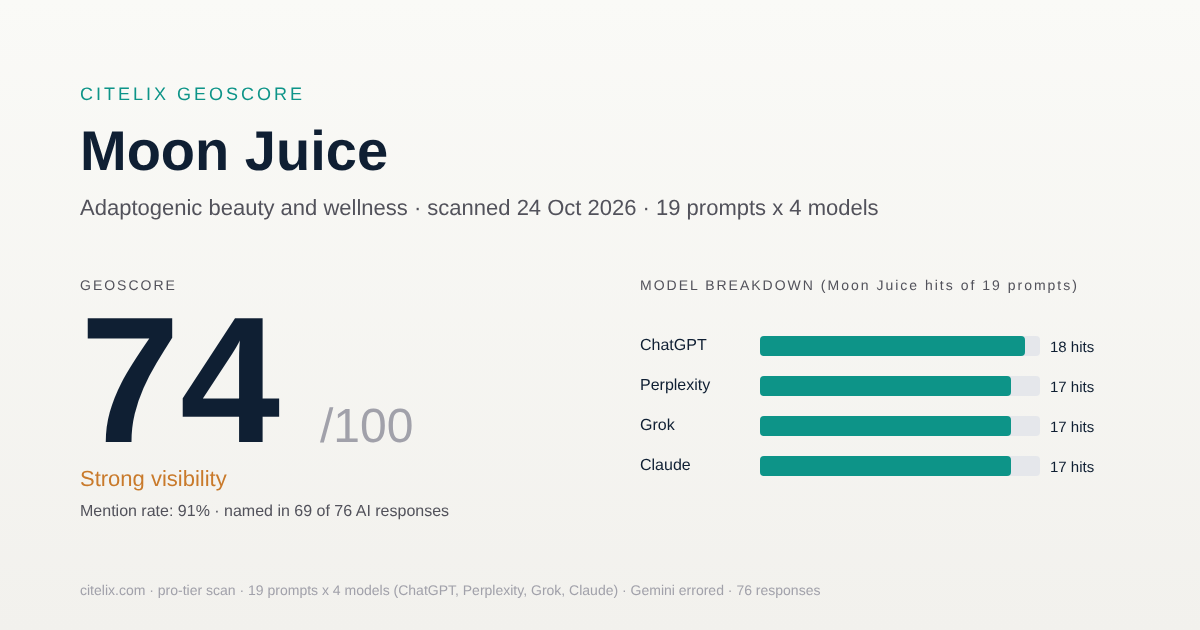
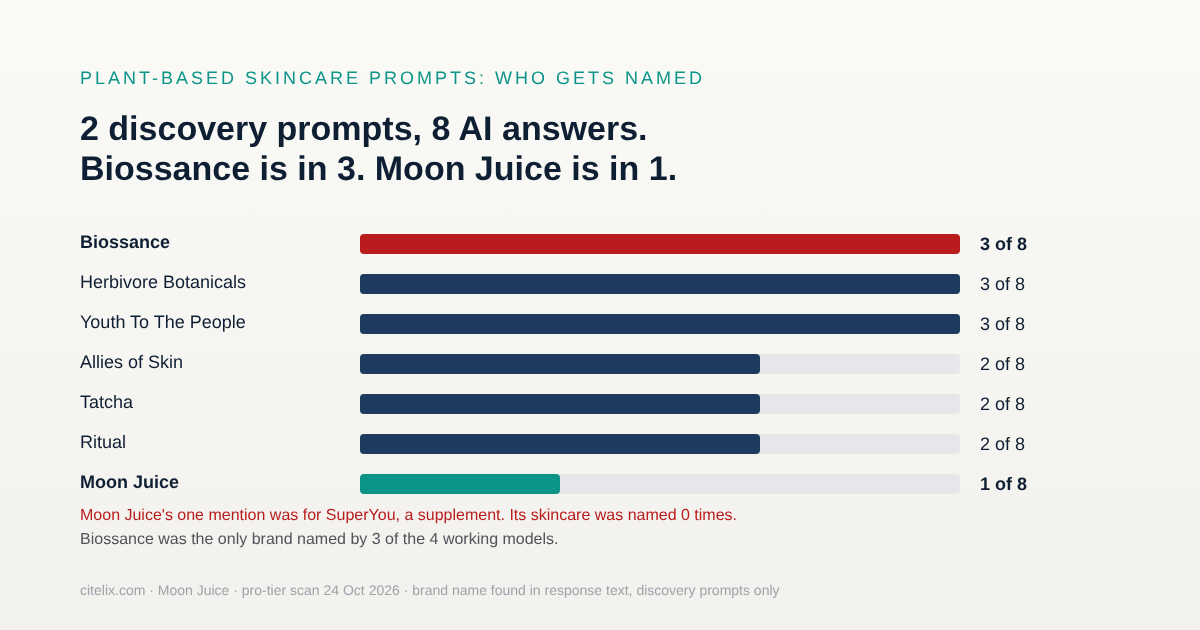
So I expected Moon Juice to show up when I asked the models how plant-based adaptogen skincare compares to traditional serums. I scanned the brand across ChatGPT, Perplexity, Grok, and Claude this week (Gemini errored, more on that below). Moon Juice came back with a Citelix GeoScore of 74 out of 100 and was named in 69 of 76 answers. On the adaptogen skincare prompt, it was named in 0 of 4. Biossance, a brand that was not on the scan’s competitor list, was the one name that showed up across three different models on the two skincare discovery prompts.
The prompt I tested
The scan ran 19 prompts across Moon Juice’s supplements, stacks, and skincare. The anchor for this teardown:
“how does plant based adaptogen skincare compare to traditional serums”
Why this prompt: it is the question a buyer asks right before they try adaptogen skincare for the first time. It is the category Moon Juice’s skincare line was built for, and the buyer has not picked a brand yet.
What Grok said
Grok gave the most product-heavy answer. It walked through mechanisms and evidence, then listed “Brands & flagship products” as head-to-head pairs: Allies of Skin vitamin C against its ginseng and mugwort serum, Drunk Elephant C-Firma against Protini, and The Ordinary “Buffet” against Biossance Squalane + Omega Repair Cream, which it described as “squalane + adaptogenic gotu kola.” No Moon Juice.
The other models:
- ChatGPT named Herbivore Botanicals, Youth To The People, and Nécessaire as adaptogen examples, and SkinCeuticals, Estée Lauder, and The Ordinary as traditional serums.
- Perplexity used Perricone MD as its example, naming its holy basil serum and chaga products, and cited perriconemd.com and kiehls.com.
- Claude explained the research without naming a brand. Its sources were jcadonline.com, nyscc.org, a dermatology practice, and one brand shop.
The second discovery prompt, “what to look for in a premium plant based skincare and supplement stack,” went a little better. ChatGPT named Moon Juice once, as an example of ashwagandha: “like in Moon Juice’s ‘SuperYou’ supplement.” That is the only Moon Juice mention across both skincare prompts, and it was for a supplement.
The discovery gap
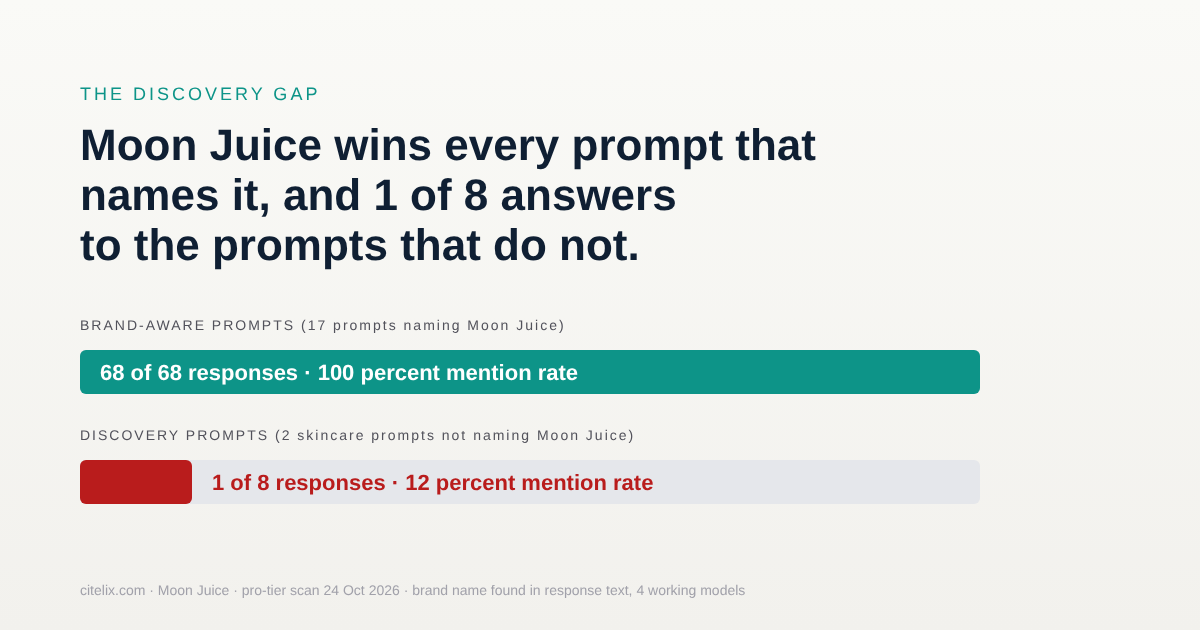
This scan leaned heavily on prompts that name the brand, which is why the GeoScore is high.
- Brand-aware prompts (17): Moon Juice was named in 68 of 68 answers. It also held up in head-to-heads. On “Moon Juice vs Four Sigmatic for stress relief adaptogens,” Perplexity ranked Moon Juice SuperYou first “for targeted stress relief.”
- Discovery prompts (2): named in 1 of 8 answers, and never for skincare.
Why Biossance won the skincare prompts
I read all eight discovery answers, the sources they cited, and both brands’ sites. Four things stand out.
1. Biossance is known for one ingredient, and every product says it
Biossance’s homepage title is “Biossance Award Winning Squalane for Skin,” and the products the models named carry that ingredient in the name: Squalane + Amino Aloe Gentle Cleanser (Perplexity), Squalane + Omega Repair Cream (Grok), and its hyaluronic acid products (ChatGPT). When a model needs a plant-based example for a step in a routine, a product named after its plant-derived active is easy to place.
2. Moon Juice’s skincare pages lead with hyaluronic acid, not adaptogens
The Plump Jelly page’s title is “Natural Hyaluronic Acid & Hydrating Face Serum.” The word adaptogen appears once on the whole page, in a single sentence about reishi supporting the skin barrier. The skin care collection is titled “Natural, Organic & Clean Skin Care Products.” A buyer asking about adaptogen skincare is asking for the one thing Moon Juice is famous for, and the skincare pages do not say it.
3. The adaptogen content Moon Juice owns is all about supplements
Moon Juice runs 7 blogs with 299 article URLs in its sitemap. Six have “adaptogen” in the slug: what are adaptogens, the best adaptogens for energy, for stress, and for sleep, adaptogens vs nootropics, and a pudding recipe. None of them is about topical adaptogens or how they compare to serums. The closest is an ingredients article on reishi for skin. Perplexity built its answer from brand pages that do cover this (perriconemd.com and kiehls.com) and Claude from research write-ups.
4. Retail and roundup presence carries skincare answers
Outside moonjuice.com (31 citations), the domains this scan cited most were thegoodtrade.com (12), ulta.com (11), and amazon.com (10). Look at which Moon Juice pages those domains sent the models to. All five Ulta product pages cited were supplements (SuperBeauty, SuperYou, Brain Dust, SuperPower, and Magnesi-Om), and the four thegoodtrade.com articles were about ingestible beauty, stress, focus, and a Magnesi-Om review. Off its own site, the web describes Moon Juice as a supplement brand, so that is how the models file it.
What Moon Juice is missing
I checked moonjuice.com by hand. For this prompt:
- No adaptogen language on the skincare. Plump Jelly mentions adaptogens once and sells itself as a hyaluronic acid serum.
- No answer to the comparison. Nothing on the site explains how adaptogen skincare compares to vitamin C, retinol, or hyaluronic acid serums, which is the question models were asked.
- No skincare in the adaptogen articles. The six adaptogen articles are about what you eat.
Credit where due: the technical basics are in good shape. The Plump Jelly page has Product schema with brand, price, and an AggregateRating of 4.8 from 826 reviews, plus FAQPage markup with six questions. When a buyer names Moon Juice, every working model answers with Moon Juice. The gap is category language, not plumbing.
3 fixes Moon Juice could ship this week
None of these need a new product.
Fix 1: Write the comparison article the models were asked for
Why this matters: the anchor prompt is a comparison question, and every model answered it with a table or a side-by-side. Moon Juice owns the category and has no page that answers it.
How to do it: Publish “Adaptogen skincare vs traditional serums” on the ingredients blog. Compare reishi, silver ear mushroom, and the other Beauty Shroom ingredients against vitamin C, retinol, and hyaluronic acid serums in one table: what each does, who it suits, and how to layer them. Link Plump Jelly, Acid Potion, and Cosmic Cream from the table, and add FAQPage markup to the article.
Estimated time: 1 day.
Fix 2: Say “adaptogen” on the skincare pages
Why this matters: Plump Jelly’s title and the collection title describe a hyaluronic acid serum and “clean skin care.” A model looking for adaptogen skincare has no reason to pick them.
How to do it: Retitle the collection to something like “Adaptogenic Skincare: Beauty Shroom Serums and Creams” and give it a 100-word description that names the adaptogens in each product. On Plump Jelly, add “adaptogenic” to the title and lead the description with reishi and silver ear mushroom alongside the hyaluronic acid. Add one FAQ to the existing FAQPage block: “How is adaptogen skincare different from a regular serum?”
Estimated time: 2 hours.
Fix 3: Get the skincare into skincare roundups
Why this matters: thegoodtrade.com and ulta.com were the most cited outside domains in this scan, and the skincare answers were built from roundups and retail listings where Moon Juice reads as a supplement brand.
How to do it: Pitch Plump Jelly and Cosmic Cream to the clean and adaptogen skincare roundups on thegoodtrade.com, byrdie.com, and vogue.com (both cited in this scan), leading with the 826 Plump Jelly reviews and the adaptogen ingredients. Make sure the Ulta listings use the same adaptogen language as the new collection page.
Estimated time: 1 hour to send, weeks to land.
The 30-second version
If you only do one thing: publish the “adaptogen skincare vs traditional serums” comparison on moonjuice.com. Moon Juice was named in 68 of 68 answers when a buyer typed its name, but on the two plant-based skincare prompts its skincare was named 0 times while Biossance was named by three different models. Plump Jelly has 826 reviews and solid schema. It just never calls itself adaptogen skincare.
Methodology
I ran this scan through Citelix on 2026-10-24 (pro-tier, 19 prompts across ChatGPT, Gemini, Perplexity, Grok, and Claude, Claude collected via batch and complete). All 19 Gemini calls returned an API billing error, so this teardown uses the 76 responses from the other four models. The GeoScore of 74 is the scan’s final score on those responses. Only 2 of the 19 prompts did not name Moon Juice, so the discovery sample is small: 8 answers. Every mention count here comes from searching the full response text for each brand name. Biossance, Herbivore Botanicals, Youth To The People, Allies of Skin, and Tatcha were not among the 10 competitors the scan tracked. Site details come from moonjuice.com’s product feed, sitemaps, and the Plump Jelly page, and from biossance.com, on the same day.
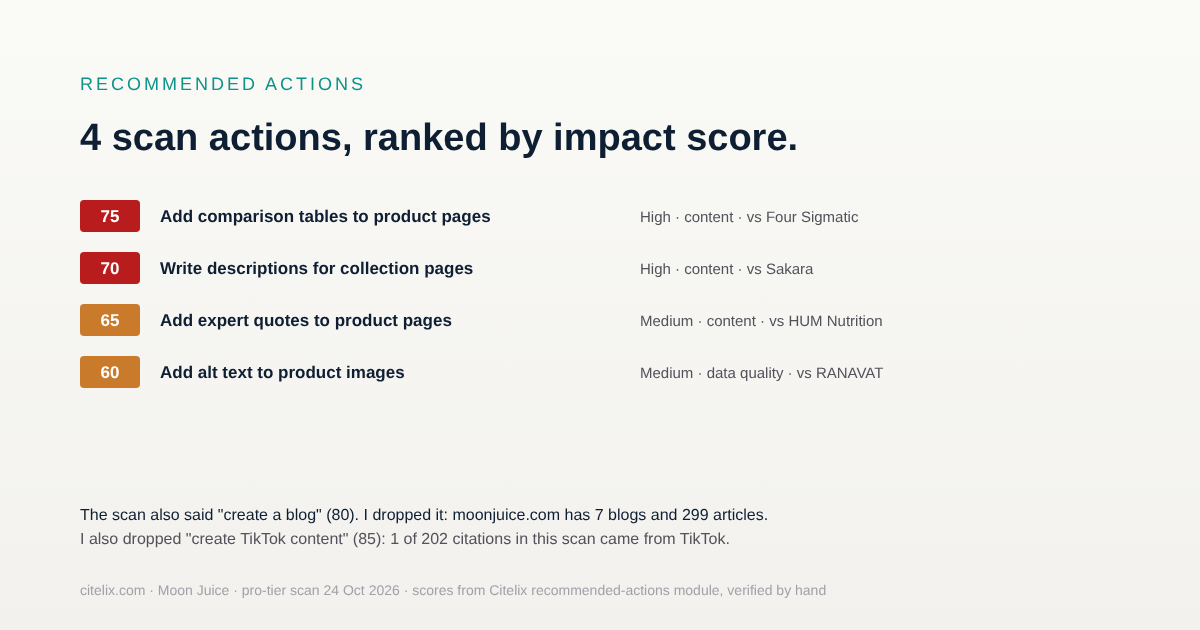
Data notes: the scan recommended “create a blog,” saying the store has no blog posts. moonjuice.com runs 7 blogs with 299 articles, so I left that out. It also recommended creating TikTok content because competitors are cited from TikTok; only 1 of the 202 citations in this scan came from TikTok, so I left that out too. One more: Claude’s Four Sigmatic comparison quoted a review of Moon Juice Spirit Dust, which is not in Moon Juice’s current 64-product catalog. This teardown is independent and not sponsored by either brand.
Want this teardown for your store? Install Citelix on Shopify. We scan your store across ChatGPT, Gemini, Perplexity, Claude, and Grok every day and tell you exactly which prompts your competitors win and what to change.